


Palm Bay Planning
Account for sewer service, lagoon treatment rules and the usable space on your parcel.
Palm Bay Septic Solutions provides septic tank and drain field services in Palm Bay, FL. Our team handles septic tank pumping, cleaning, real estate inspections, repairs, installation, and replacement for residential and commercial properties. We also handle drain field inspections, repairs, and replacement.
We plan septic care around your property’s needs. Our approach connects the tank, treatment equipment and drain field before recommending work, with clear scope and practical maintenance in mind. Palm Bay’s wet-season groundwater, sewer availability and Indian River Lagoon requirements can affect the right repair or installation. Expected service life depends on the installed product, site conditions and maintenance.
Account for sewer service, lagoon treatment rules and the usable space on your parcel.
Separate maintenance, damaged components and field trouble before choosing the work.
Explain starting prices, access needs, add-ons and the work included in a proposal.
Consider the home or business use, wastewater type and operating needs.
Make pumping, cleaning, repair and replacement choices easy to compare.
Connect the service findings with a practical plan for the tank, field and equipment.
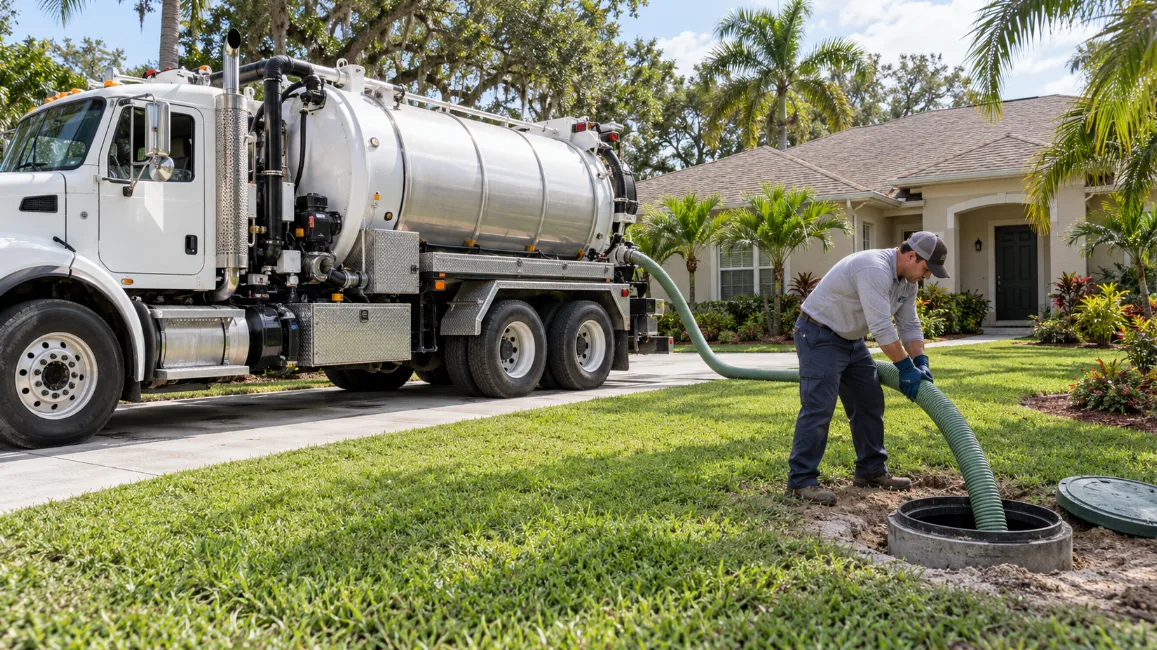
Routine care, a recurring backup or a new system: each starts with a clear scope and the property’s actual needs.
Remove accumulated sludge and scum, inspect accessible tank components, and plan the next service around measured solids, tank capacity and use. Residential and commercial pumping are scoped separately.
Explore Septic ServiceRemove suitable deposits and inspect accessible filters and outlets after bulk waste removal. Agree on pumping, wash-down, deeper cleaning and disposal before comparing prices.
Explore Septic ServiceAssess accessible tank parts, operating levels and system records. Real estate inspections document findings and access limits, with field evaluation added when the scope calls for it.
Explore Septic ServiceDiagnose damaged lids, baffles, fittings, filters, pumps and other components before choosing a repair. Permitted repair scope and full-system replacement are different decisions.
Explore Septic ServicePlan new installations and replacements around the home, soil, groundwater, sewer availability and required treatment. Compare the complete permitted scope and ongoing maintenance before selecting a system.
Explore Septic ServiceRequest urgent help for a high tank level, sewage backup or overflow. Share water levels, ground conditions and alarms so the cause and safe service options can be assessed.
Explore Septic Service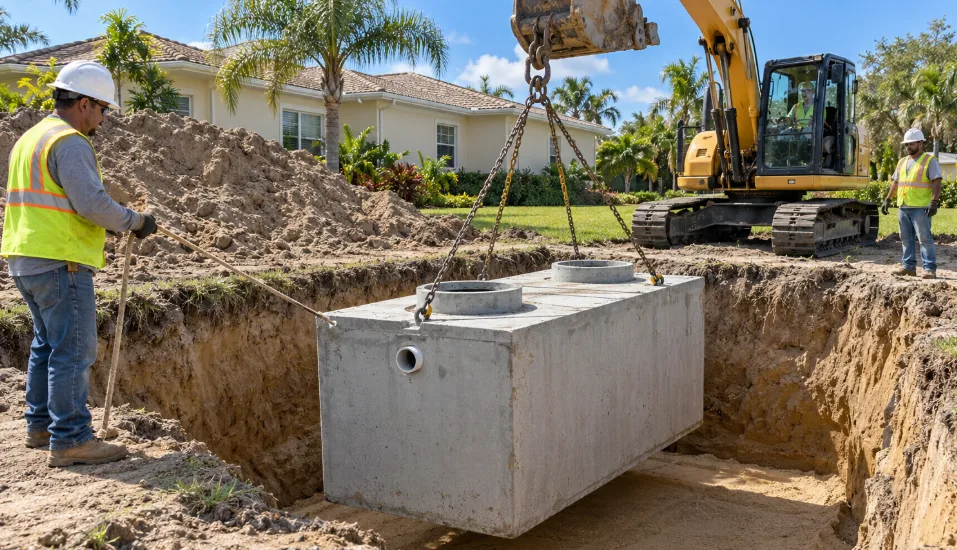
A tank can be sound while the field struggles. Review distribution, soil and groundwater before deciding on repair or replacement.
Assess distribution pipes, roots, damaged components and receiving soil before choosing a drain field repair. Separate a repairable defect from a disposal area that needs redesign or replacement.
Explore Drain Field ServiceReview field records, distribution, drainage symptoms and site constraints before a repair, property purchase or addition. Document observed conditions and the limits of the evaluation.
Explore Drain Field ServicePlan a replacement disposal area around usable space, soil, wet-season groundwater and current treatment requirements. Check sewer service before committing to a new field layout.
Explore Drain Field Service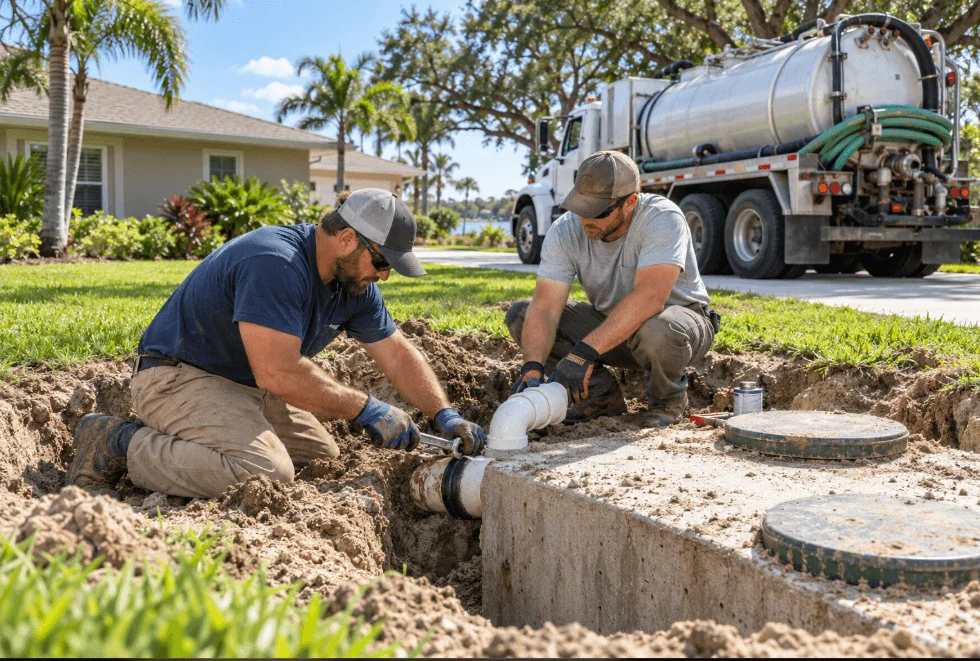
Palm Bay and nearby southern Brevard communities’s median listed-home size was 1,717 square feet in September 2026, according to the Realtor.com series published by FRED. This gives Palm Bay owners a regional comparison; it is not an average for all city homes or homes on septic. A three-bedroom, two-bath home around 1,700 square feet is a useful example, rather than a measured citywide standard.
Use the actual floor plan and permitted bedrooms. An extra bathroom does not, by itself, determine tank size. A converted room, addition or new business use may change the design demand and approval needed.
September 2026 county data · What the listing-size series measures
900, 1,050 and 1,200 gallons are useful Florida storage examples. For the matching three-bedroom category, a home from 1,201 to 2,250 square feet has a 300-gallon-per-day design flow and a 900-gallon minimum effective tank capacity. Extra treatment chambers, pump storage and the selected equipment can increase the total installed volume.
| Home example | Design flow | Minimum tank storage |
|---|---|---|
| 2 bedrooms, 751–1,200 sq ft | 200 gallons/day | 900 gallons |
| 3 bedrooms, 1,201–2,250 sq ft | 300 gallons/day | 900 gallons |
| 4 bedrooms, 2,251–3,300 sq ft | 400 gallons/day | 1,050 gallons |
| A residential design at 401–500 gallons/day | 401–500 gallons/day | 1,200 gallons |
Examples from Rule 62-6.008, Tables I and II. When bedroom count and building area differ, the higher resulting demand controls. These are storage minimums, not a complete design or a survey of installed Palm Bay tanks.
A 400-gallon-per-day aerobic treatment rating is a treatment capacity, not a 400-gallon tank. The drain field is sized separately for the permitted flow, soil and approved disposal method. Check your permit record or tank label before arranging service.
DOH-Brevard handles local septic permitting and inspections under Florida DEP rules. Palm Bay Utilities confirms sewer availability, and the City Building Division handles related building and plumbing approvals. These are separate reviews.
Check sewer availability and the parcel’s nutrient-reduction requirements before paying for a replacement design. A nearby sewer main or a planned extension needs an address-specific answer from Utilities.
Brevard construction permit office · Palm Bay service availability
Use 4–6 business days as an initial processing allowance once a complete application and required fees are received. This is our planning allowance, not a published Brevard average or guaranteed permit approval. Confirm the current queue with DOH-Brevard before scheduling work.
County-staff site evaluations carry a minimum 48-hour utility-locate hold. Missing documents, site access, design revisions, workload, other approvals and inspection scheduling can extend the project.
Completed application, legal description, floor plan showing bedrooms and building area, signed site plan, owner authorization when needed, and applicable site-evaluation or engineering data. Include the deed if recently purchased.
Identify the failed parts and proposed scope. Brevard’s repair packet also asks for an existing-system/repair evaluation and water-use records for properties on municipal water.
Show existing and proposed layouts. Bedrooms, floor area, wastewater strength and commercial use can affect the review. Pools, sheds and patios may also need a separate septic site-plan review.
New-system checklist · Repair checklist · Modification checklist
| Review or stage | Timeframe | What to know |
|---|---|---|
| Initial septic processing plan | 4–6 business days | Owner planning allowance after complete submission; ask DOH-Brevard for its current queue. |
| County-staff site evaluation | At least 48 hours on hold | Utility locating; this is not the whole evaluation or approval time. |
| Qualifying engineer-designed performance-based application | 5 / 15 working days | 5 days to request missing information; 15 after completeness for permit issuance or noncompliance notice and referral. |
| Repair application | Two working days: effort standard | Rule 62-6.015 directs the agency to make every effort; it does not guarantee approval or completion in two days. |
| Related City building permit | About 14 residential / 28 commercial working days | City-published building review estimates; separate from septic approval, with other departmental approvals possible. |
General Florida licensing law usually provides a 30-day application-deficiency notice period and a 90-day approval-or-denial period after completeness, unless a shorter law applies. Proceedings and other statutory provisions can affect the clock. None of these dates is permission to start work without the required issued approvals. Design, installation, final inspection and closeout are separate stages.
Engineer-designed review law · Repair rule · City review estimates · General review law
The Brevard packets marked Rev 08/26 list new-system fees of $395 with submitted site-evaluation data or $510 without; new performance-based system fees are $405 or $520, respectively. Repair fees are $320 with submitted site-evaluation data or $435 without, and abandonment is $70. Confirm the applicable fee and any extra inspections, density review, operating permit, engineering or City charges. These agency charges are separate from our service pricing.
For covered Indian River Lagoon plan areas, new systems installed from January 1, 2024, unless previously permitted, must use sewer where available. Where sewer is unavailable, approved treatment must achieve at least 65% nitrogen reduction. A conventional tank alone or an added aerator is not proof of compliance.
Under section 373.469, Florida Statutes (2026), by July 1, 2030, covered existing systems on commercial property or residential property of 10 acres or less must connect to available sewer or meet the required nitrogen reduction. Check the parcel and current implementation with DOH-Brevard and Palm Bay Utilities. Do not apply that deadline to an address solely from its ZIP code, or assume every repair immediately requires the same complete replacement.
Before comparing quotes, ask whether the price includes the approved treatment model, field design, electrical work, required operating permit, service agreement and final inspections. Routine pumping does not replace a required upgrade. Sewer conversion also needs a septic abandonment permit and applicable City plumbing/building permits.
Sludge and floating waste can escape the tank when maintenance is overdue and obstruct the field.
Running fixtures, concentrated laundry and changed property use can exceed the system’s demand allowance.
Grease, wipes and other waste can obstruct parts or interfere with treatment.
Heavy rain and high groundwater can reduce the soil’s ability to accept and treat wastewater.
Roots, broken pipes, paving and vehicle traffic can damage components or compact the disposal area.
A changed floor plan, failing pump, neglected blower or damaged controls can interrupt system performance.
A septic system is more than a tank. Its storage capacity, treatment process and drain field each do a different job. Use this guide to understand home size, tank materials, expected lifespan and Palm Bay conditions before choosing a service.
A Palm Bay septic plan starts with permitted bedrooms, building area and use. The 1,717-square-foot county listing median is background context, not a design rule. A three-bedroom home around 1,700 square feet can fit the state’s 300-gallon-per-day flow example; more area or bedrooms can move it into a higher category.
Bathroom count is useful when describing a property, but adding a bathroom does not automatically double storage. Bring the floor plan, prior permit and any approved additions to the discussion.
Storage is the tank’s effective liquid volume in gallons. Treatment capacity is the daily flow an approved unit can process. Drain field area is the soil-disposal area needed for that flow and site. These are three different measurements.
Florida storage examples include 900 gallons for up to 300 gallons/day, 1,050 for 301–400, and 1,200 for 401–500. The permitted design and equipment govern the final installation. A larger tank does not make saturated soil drain faster.
For an existing system, request the approval record and compare it with tank markings or a professional capacity measurement. Historical Brevard records may be available through the resources linked by DOH-Brevard. A tank’s appearance alone does not establish its approved size.
Heavy and rigid, with lifting access and a prepared base needed. Covers, seams and walls deserve inspection for damage or leakage.
Lighter composite construction. Shell condition, fittings, bedding and the approved model’s groundwater provisions matter.
Molded plastic construction. Correct backfill, burial depth and anchoring where required help prevent deformation or movement.
The tank shell, field, pump, blower and controls can have different service lives. Condition, leakage, treatment performance and repair options matter more than the material name or age alone. Expected life depends on the selected product, installation, site conditions and maintenance; it is not a promised warranty.
A conventional tank separates solids before liquid enters the field. Aerobic units use oxygen and may need powered equipment. Performance-based systems are designed for stated effluent standards. An in-ground nitrogen-reducing biofilter is another technology listed by DEP; suitability depends on the parcel and approved design.
“Aerobic” does not automatically mean approved nitrogen reduction. Confirm the specific model and treatment train, along with permit, servicing and monitoring obligations. DEP’s enhanced-treatment guidance explains the approved categories.
City drainage uses swales, ponds, pipes and canals. Wet weather can leave the disposal area unable to accept wastewater. Keep roof and yard drainage away from the field; pumping the tank does not lower surrounding groundwater.
Palm Bay says some swales hold rainwater for up to 72 hours after minor storms. Longer retention can warrant a Public Works report. This is stormwater guidance, not a safe waiting period for sewage surfacing near the field.
Wells, setbacks, access, easements and future pools or paving compete for space. Have the septic footprint located before a new structure or driveway is planned.
The City identifies Turkey Creek and direct discharge as routes by which much of Palm Bay’s drainage reaches the Indian River Lagoon. Sewer and nutrient-treatment checks belong in a replacement decision.
Pumped and advanced systems depend on working controls, alarms and treatment equipment. A warning light, high-level alarm or power interruption needs the right diagnosis; avoid repeatedly resetting equipment.
Running fixtures, concentrated laundry, added bedrooms and changed commercial use can overload treatment or disposal. Match current use to the system approval before deciding on a larger tank.
These are locally relevant risks and diagnostic checks, not a measured ranking of failures across Palm Bay. Soil and wet-season groundwater vary by parcel.
Reduce water use and keep people and pets away from sewage. Do not open or enter a tank. Saturated ground or floodwater can make pumping unsafe because a tank can move or float. Describe the ground conditions when arranging professional help.
Palm Bay drainage FAQ · City watershed information · EPA flooding guidance
Practical answers for Palm Bay homes and businesses.
EPA gives a general three-to-five-year household interval. Actual solids, occupancy, tank size and water use determine the schedule; advanced equipment has its own maintenance requirements.
For the matching 1,201–2,250-square-foot category, Florida’s basic example is 300 gallons/day design flow and 900 gallons minimum effective storage. The actual permitted treatment train and any added demand govern the final design.
No. It is Palm Bay and nearby southern Brevard communities’s median listed-home size for September 2026. It is useful regional context, not a citywide average or a measurement of septic-served houses.
DOH-Brevard handles local septic permits and inspections under Florida DEP rules. Palm Bay Utilities and the City Building Division handle their respective sewer and building/plumbing reviews.
Allow 4–6 business days initially after complete submission, then confirm the current queue with DOH-Brevard. This is our planning allowance, not a guaranteed approval. County-staff evaluations include a minimum 48-hour utility-locate hold; design, workload and other reviews can add time.
No. Verify the parcel, sewer availability, applicable plan area and permit scope. Covered new systems must meet the applicable 65% nitrogen-reduction requirement where sewer is unavailable; approved technologies and site designs differ.
The 2026 Indian River Lagoon statute covers existing systems on commercial property or residential property of 10 acres or less in the named plan areas. They must connect to available sewer or achieve the required nitrogen reduction. Verify your address and current requirements with the agencies.
Yes. Describe the business use, capacity if known, operating needs, access and waste type. Commercial and grease-interceptor requests need a specific scope.
No. Requests do not confirm availability, arrival or an appointment. Reduce water use and obtain prompt professional help for an active sewage backup.
Tell us where you are, what is happening and the service you need.